Free doesn’t have to for nothing: How to turn your advent calendar into a lead magnet and trade 24 little doors into 365 days of staying in touch.
Trade 24 little doors finto 365 days of staying in touch
You’ve decided to create an advent calendar and are putting weeks of work into 24 lovingly prepared little doors, each one sharing your expertise – brilliant. And then, on 25 December, everyone disappears again: You have no names of the people who took part, no contacts, nothing to build on in the new year. A bit of a waste of all that effort, isn’t it?
That’s exactly why I offer my advent calendar for free, but not for nothing 😉 It’s my most successful lead magnet, year after year. I enjoy sharing what I know and making people happy with useful content. At the same time, I’d also like to stay in touch after Christmas with the people who are interested in what I have to share.
A quick detour: What are lead generation and a lead magnet?
Put simply, lead generation means turning interested people into contacts you can continue to reach, with their permission. A lead magnet is a free offer that encourages people to sign up, for example with their email address. It could be a workbook, a checklist or, of course, an advent calendar.
In this post, I’ll show you how to make your advent calendar not just a gift for your community, but also the best opportunity of the year to grow your newsletter list with people who are genuinely interested in your topic. I’ll use my favourite combination as an example: Your own website (WordPress and Elementor in my case) plus an email marketing platform (MailerLite for me).
Already chosen your channel? Perfect. Now let’s look at how to make the whole thing work.
How to turn your advent calendar into a lead magnet
The 24 little doors are the gift, the connection stays
When someone signs up for your advent calendar, more happens than a technical registration for 24 little doors. They’re also telling you: “I’m interested in your topic. I’d like to see more, and I’m happy to let you into my inbox for it.”
That’s a pretty good starting point for what I call relationship-based marketing. Over several weeks, you can show people who you are, how you work and what you know. They get the chance to find out at their own pace whether they like you and whether your way of working suits them.
That’s exactly why I recommend not simply putting your advent calendar out in the open on your website and linking to a different door somewhere every day. You may get a few website visitors that way, but you won’t know who’s genuinely interested in your topic. With a sign-up, things look different: You build a list of people who have actively chosen your content and whom you can reach after Christmas, provided you have the appropriate consent.
For me, that’s the real value of an advent calendar: You give away 24 little doors while laying the foundations for 365 days of staying in touch.
How your advent calendar becomes a little funnel
Donut worry 🍩 You don’t need a complicated funnel with seven layers, three different landing pages and an automated sales webinar designed to talk people into taking part.
The process is surprisingly straightforward: Awareness → landing page → sign-up → double opt-in → welcome email → daily doors → regular newsletter.
You promote your advent calendar on your channels and send interested people to your sign-up page. Once they’ve signed up and confirmed their subscription, they receive the promised content. Over those 24 days, they get to know you and your work better, and afterwards you can keep the connection going through your regular newsletter.
Let’s look at what matters at each step.
Your landing page is the gateway
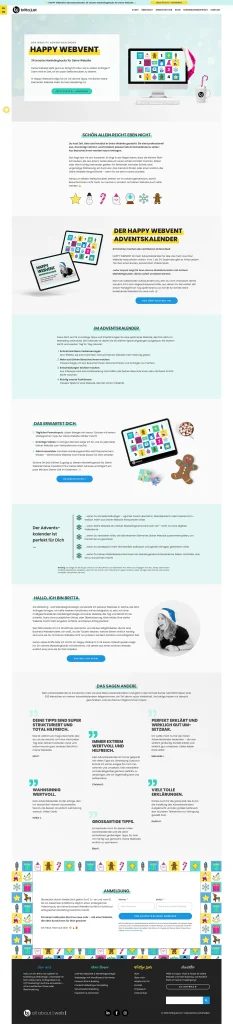
Send everyone who’s interested to a dedicated landing page for your advent calendar. Explain what participants can expect, who the calendar is for and why signing up is worthwhile. And, of course, the page needs a sign-up form.
So your landing page isn’t just pretty wrapping for your calendar; it’s where an anonymous visitor becomes a contact.
Sign-ups, not open doors for everyone
Once someone signs up on the landing page, their details are passed to your email marketing platform. I use MailerLite and have created a separate group for my advent calendar. That way, I can see later who originally signed up through this campaign.
Make sure double opt-in is enabled, too. The person receives a confirmation email and has to confirm their subscription before they’re added to your list.
And here comes the crucial bit for me: If you want an advent calendar contact to become a long-term newsletter contact as well, make sure the consent is properly set up at sign-up. Be clear that people are signing up not only for the advent calendar but also for your regular newsletter, and that they can unsubscribe at any time from any email with a single click on the relevant button or link.
After signing up comes the welcome
Okay, you’ve set up sign-ups in mid-October, but the first little door won’t open until 1 December. So do you just sit on your hands and leave your new contacts waiting until then? Not a chance.
Set up an automated welcome email to go out as soon as someone has confirmed their subscription. Explain what happens next, when the first door will arrive and how the daily delivery works. You can also use the opportunity to introduce yourself to people who don’t know you yet and give them a little taste of what’s coming in your advent calendar.
That means you’re already starting to build a relationship with your new contacts.
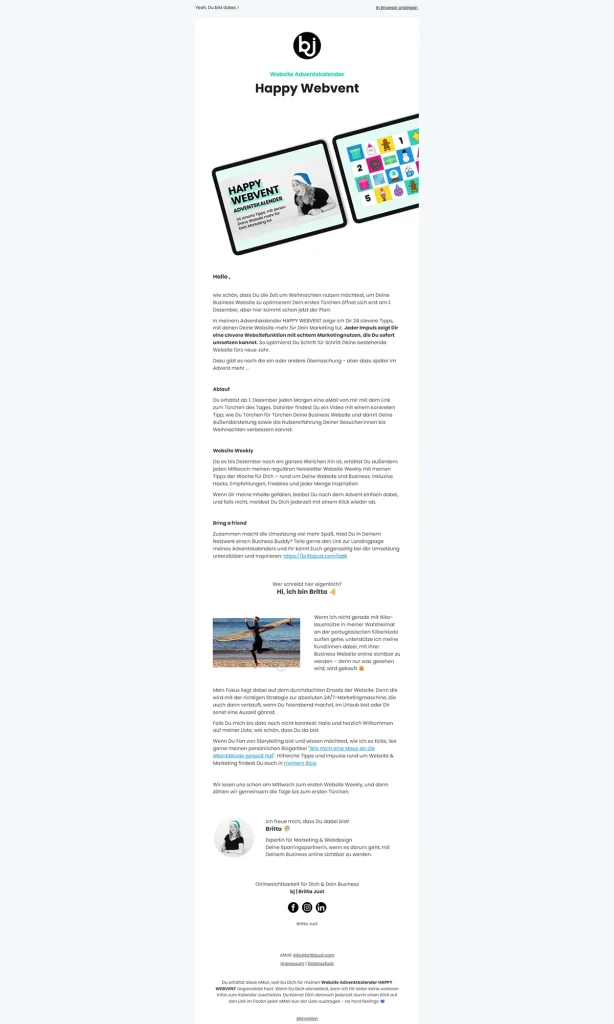
My tip: Tailor the welcome email to the date someone signs up. Someone who joins in October needs different information from someone who signs up at the end of November, or someone who joins on December 8th. You can get early sign-ups ready for the launch, for example, while latecomers can be told straight away where to find the content that’s already been published.
The calendar starts – so, 24 doors = 24 emails?
From 1 December onwards, your participants receive a little door every day. You can send the emails as scheduled campaigns or manage the whole delivery process through an automation.
With MailerLite, I prefer scheduled campaigns. That way, people who sign up after the advent calendar has started receive the email with the latest door, rather than having to start all the way back at Day 1.
I also try to make things easy for people: 24-plus advent calendar emails on top of the usual Christmas chaos might be a bit much for anyone’s inbox. So after a few days, I give participants the option to switch from daily to weekly delivery with a single click. They then receive just one email every advent Sunday, containing the previous seven doors all at once – perfect for an advent calendar video marathon 😉
Should you send your regular newsletter at the same time?
During my advent calendar, I don’t just send participants the daily door emails; I also keep sending my usual weekly newsletter, Website Weekly.
I wouldn’t recommend doing that across the board, though. It depends on how often you normally send emails, how substantial your content is, and how well it fits your audience and the advent calendar. In December, inboxes are busy enough as it is.
It works for me because people get to experience first-hand what they can expect after the advent calendar, too. They become familiar with my topics, my writing style and the way I work, rather than suddenly receiving a newsletter in January that feels completely different from the emails they’ve had so far. If they like it, they stick around; if not, they can unsubscribe with a single click.
If you’d rather pause your regular newsletter during the advent calendar, that’s perfectly fine, too. The important thing is to decide in advance how you’ll ease your new contacts into your usual newsletter rhythm afterwards.
Keep an eye on what works
Another advantage of combining a website with an email newsletter for your advent calendar is that you can already see which content your participants respond to best while it’s running. Which doors get opened most often? Which links get clicked? Which topics prompt replies or comments?
You don’t need to turn this into a complicated data analysis. Simply checking the available open and click rates regularly can help you get a better sense of what your community is interested in. Bear in mind that open rates aren’t always reliable for technical reasons; clicks and direct feedback can provide useful additional clues.
You can put what you learn to good use in the new year: A popular door might become a blog post, a topic could turn into a newsletter, or a frequently mentioned problem might inspire a workshop. That way, your advent calendar keeps supplying content for the months ahead instead of disappearing into a drawer once Christmas is over.
And what happens after December 24th?
This is where you find out whether your advent calendar has really been designed to last. When the final door opens on 24 December, the connection shouldn’t end up in the recycling with the Christmas tinsel. You’ve invested time, knowledge and energy, and spent 24 days building trust. Perhaps your participants have already tried out a few tips, read your emails and got a feel for who you are and how you work. It would be a shame to go completely quiet now, wouldn’t it?
That’s why I carry on sending my regular newsletter after the advent calendar, too. You can make the transition feel more personal with festive greetings or a little Christmas gift before returning to your usual content in the new year. And if you like, you can make a relevant offer in January that builds on the advent calendar topics. It doesn’t have to be a one-to-one collaboration straight away. A small workshop or another paid introductory offer might be the more sensible next step.
There’s one thing you shouldn’t forget, though: Not every participant will eventually become a client. Some will simply enjoy the 24 little doors, others will read your newsletter for a while before unsubscribing. And some will stay for months or years without ever buying anything.
That’s absolutely fine. To me, marketing isn’t just about turning a contact into a paying client as quickly as possible. It’s also about giving people the chance to get to know you and decide for themselves whether you’re the right person for them.
Checklist: Your advent calendar as a lead magnet
So you don’t forget anything while planning, here are the key points in checklist form:
- ✅ A dedicated landing page with a clear promise and sign-up form
- ✅ A newsletter list or group for advent calendar sign-ups
- ✅ Double opt-in enabled
- ✅ Clearly worded consent covering both the advent calendar and your regular newsletter
- ✅ A working technical connection between your website and email marketing platform
- ✅ An automated welcome email sent after confirmation
- ✅ Scheduled or automated delivery of all 24 little doors
- ✅ Optional: A way to switch from daily to weekly delivery
- ✅ Keep an eye on open and click rates, and review feedback
- ✅ A plan for staying in touch with your contacts after December 24th
Because that’s the difference between an advent calendar that simply publishes 24 nice pieces of content and one that continues to do something for you in the long run.
That’s why free doesn’t mean for nothing
You give away 24 little doors and, at best, gain 365 days in which to stay in touch with the right people.