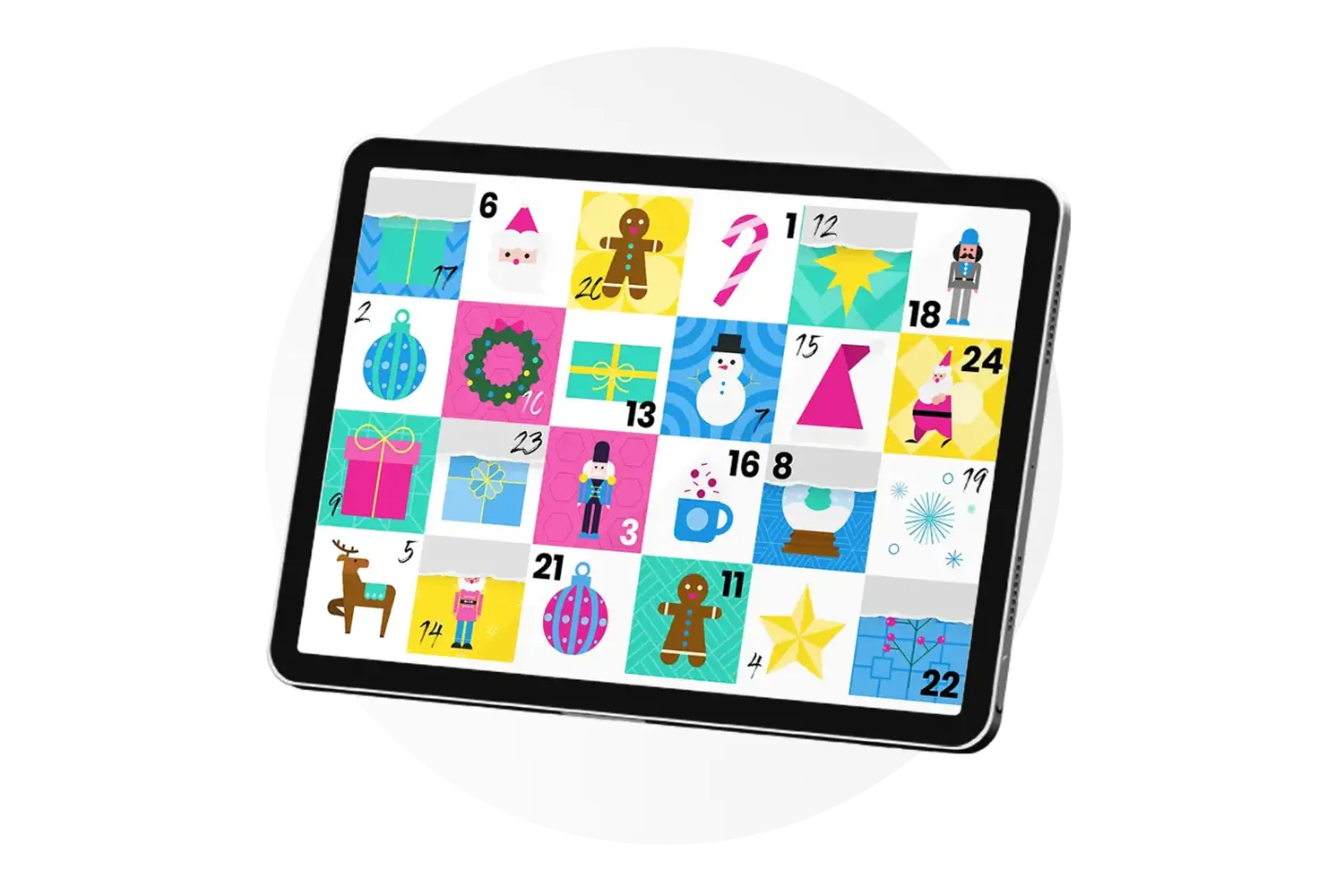
24 doors, zero ideas? No need to panic: here’s how to find the perfect topic for your advent calendar – including examples and an AI prompt to help you take a shortcut.
Oh, merry Christmas … planning an advent calendar?
Christmas is still quite a way off – and yet here you are, somewhere in the middle of autumn, because the thought of creating a digital advent calendar for your business has suddenly popped into your head. The only problem: how on earth do you actually get started?
Donut worry 🍩 Here are my tips for finding the topic for your online advent calendar as a first step – that one overarching topic you can use to fill 24 doors, delight your existing customers and, as a nice little side effect, get yourself noticed by new people.
👉 I’ve already summed up why all that effort is worth it in my post Good reasons to run an online advent calendar.
Table of contents
Right, let’s find your advent calendar topic
First things first: grab a blank sheet of paper and a pen, and take a little time to answer the following questions.
Your target audience
Who is your advent calendar for? Who is the ideal customer you want to delight with it? What challenges are these people facing, and how do those challenges connect to what you offer? Are they complete beginners, or are they already quite a way into the topic?
In my case, pretty much everything revolves around using your business website as a 24/7 marketing tool. I mainly work with solo business owners who don’t want to spend their lives wrestling with technology, but still want to be able to keep their website content up to date themselves. Many already have quite a bit of knowledge under their belt, but are still happy to get practical ideas and inspiration for improving their website.
Your goal
You’re not creating an advent calendar just for the fun of it. Well, not only for the fun of it, anyway. It should also help you achieve your business goals. So, what do you actually want to achieve? More visibility? Stronger customer loyalty? New customers? Or straight-up sales?
Here’s a little spoiler: with a digital advent calendar, you can work towards several of these goals at the same time – customer loyalty, attracting new people and increasing visibility all rolled into one. I would only recommend charging for your advent calendar if you’ve already built a decent reach and a loyal community, though. You can always test your content as a free advent calendar first and turn it into a paid product later – just not as a calendar anymore, but as a course, bundle or collection.
I use my advent calendar to say thank you to existing contacts – my customers and newsletter subscribers – for sticking around, while also getting in front of new people and warming them up with practical tips. Registration runs through my newsletter tool, MailerLite, so I can stay in touch with interested people afterwards, too.
I’m also very much on Team “It’s better to give than to receive”, so my advent calendars are free of charge. To make sure all that work still pays off in the long run, I take two approaches: first, I repurpose the content I create for the calendar for my blog and newsletter afterwards.
👉 I turned all posts from my 2025 advent calendar into a blog series in 2026.
And secondly, thematically focused calendars can later be bundled into a paid product. For example, I’m planning to turn my 2024 calendar about blogging with Elementor and the Block Editor into a self-paced course after giving it a refresh.
👉 My advent calendar for this year, Happy Webvent – 24 clever marketing hacks for your website, will also be repurposed as blog content in the new year.
Trends
Are there any current trends or developments you could turn into a topic that fit your area of expertise – or that simply happen to be something you care about?
I keep seeing self-employed people who have a website but are only scratching the surface of what it could actually do for their business. And quite often, it’s the small, clever tweaks that turn a pretty online business card into a proper marketing tool. That’s exactly where this year’s calendar comes in.
Format
Decide what format you want to use for your doors. Will you create texts, images, videos, audio files or interactive elements such as fill-in workbooks?
My pro tip: don’t make life harder for yourself than it needs to be. Look at what is easiest for you to create and go with that.
I’m sticking with short videos and punchy accompanying texts again this year, delivered through my website.
Brainstorm ideas for your topic
Now it’s time to brainstorm. Start by collecting every idea that comes to mind, without limiting or judging them – that bit comes later. Keep in mind that you need enough material to fill 24 doors, and don’t forget to consider your technical setup and the amount of time you actually have available.
Once you’ve got your list, go through the ideas and give them a reality check. Do they fit your target audience? Do they support your goals? Is there enough material for a whole calendar? And can you realistically get everything done by the end of November?
Still can’t decide? Ask your ideal customers for feedback.
One year, I even let my newsletter readers vote between two topics: a blog advent calendar or an accessibility advent calendar. The blog advent calendar won that particular battle.
Flesh it out
Once your topic is sorted, it’s time to work out the details. Do you want to take one aspect of your area of expertise and explore it in depth? Then your doors can build on each other logically. Or would you rather give people a broader overview? In that case, the individual doors can stand completely on their own. And, as always, keep your target audience in mind: are they already familiar with the topic, or are they starting from scratch?
My blog advent calendar, for example, was aimed at self-employed people who were already blogging but weren’t making the most of Elementor for their blogs. It wasn’t aimed at people who first needed convincing that blogging was worthwhile and then had to learn the basics. The interest in accessibility that became obvious through the vote later gave me ideas for newsletter and blog content, where I could share practical tips for making websites more accessible to people with little prior knowledge.
And by the way, your calendar doesn’t have to be purely practical. It can be entertaining, too – with a peek behind the scenes, a bit of inspiration or a few personal stories. That’s entirely up to you.
Next, break your topic down into small, tasty little bites. Try not to make the input too big, because hardly anyone feels like spending an entire hour working through a single door in the run-up to Christmas. I’d recommend creating a content plan showing what you’re going to publish on which day. It makes the whole thing much easier to organise and helps make sure you’ve actually got enough material for all 24 doors.
Inspiration: advent calendar topic ideas
Maybe your perfect digital advent calendar topic is already hiding in this list:
Nutritionist
“Enjoy your way through Advent: 24 days of healthier festive alternatives” – tips and recipes for healthier versions of traditional Advent and Christmas foods, which are often rather heavy on the calories.
Example: Reimagining cinnamon stars – a recipe for gluten-free, low-sugar cinnamon stars made with almond flour, accompanied by a time-lapse video showing how to make them.
Marketing mentor
“The customer journey: 24 steps towards lasting customer loyalty” – short explanations of the different stages of the customer journey, along with practical tips for optimising each one.
Example: The moment of decision – an infographic showing the triggers that encourage customers to buy, plus a mini checklist for optimising your own sales page.
Parenting coach for a stress-free, harmonious family life
“Ho, ho, ho instead of chaos: 24 prompts for more relaxed family moments” – daily mini prompts and rituals to take the pressure out of family life, particularly during the often hectic run-up to Christmas, and create a little more harmony.
Example: The storm is brewing – a short video showing a simple breathing exercise that children (and parents) can use together to calm an approaching tantrum, plus a little guide for creating a regular calming ritual.
Artist creating art from marble and ash
“24 layers – a dance between intuition and conscious choice” – an advent calendar that takes people behind the scenes and shares interesting stories from the studio.
Example: Colours of memory – a short video showing how different ash pigments create different shades in marble, accompanied by a personal story about how colours can trigger memories.
Mindfulness coach
“Strong and mindful: 24 exercises for a powerful new year” – practical mindfulness exercises combined with strengths work to support personal growth.
Example: Gratitude as a strength – a five-minute audio guidance for mindfully reflecting on personal strengths, followed by a gratitude exercise.
Graphic designer specialising in personal branding
“Let your brand shine across every channel: 24 design hacks for your new branding” – daily tips for using your new design consistently across your website, newsletter, workshop materials and social media.
Example: Your visual signature – a short video tutorial showing how to use your logo as a watermark on your workshop materials.
Wedding planner for couples on a small budget
“Dream wedding on a budget: 24 tips for the perfect budget-friendly wedding” – daily money-saving tips and DIY ideas for creating a stylish wedding without blowing the budget.
Example: Floral magic on a shoestring – a blog post showing how to make your own table decorations from seasonal flowers.
Voice consultant
“Alexa, open the advent calendar: 24 ways voice tech can revolutionise your business” – daily insights into the ways businesses can use voice technology.
Example: Your virtual assistant – a step-by-step guide to setting up a simple Alexa Skill for booking appointments.
Psychologist specialising in mental health at work
“Mentally fit at work: 24 power tips for a healthy workplace” – daily tips for businesses on how they can have a positive impact on the mental health of their employees.
Example: Communication is everything – an infographic covering the basics of nonviolent communication in everyday workplace situations, accompanied by practical examples.
Business consultant with a holistic approach
“A holistic approach to success: 24 prompts for a more balanced business” – daily prompts for looking at and improving different areas of a business from a holistic perspective.
Example: Yin and Yang in everyday business – a podcast episode about balancing action and reflection, including a practical exercise for structuring your day.
Fairy-tale educator and nature therapist
“Enchanted nature stories: 24 magical moments for inner balance” – daily nature-based exercises with elements of fairy tales to encourage mindfulness and self-reflection.
Example: The wise tree – a short audio file with a guided visualisation involving a conversation with a wise old tree, followed by reflection questions.
Arbitration lawyer
“Peaceful holidays: 24 insights into successful conflict resolution in inheritance disputes” – daily case studies and tips for resolving conflicts out of court when an inheritance dispute threatens to turn the family Christmas gathering into something rather less festive.
Example: The art of listening – a short role-play video demonstrating the importance of active listening during mediation conversations.
Fashion designer specialising in sustainable, handmade fashion
“Sustainable fashion moments: 24 inspirations for your wardrobe” – daily inspiration and styling tips using timeless pieces from the studio to help build a capsule wardrobe: a minimalist collection of fewer pieces that can be combined in lots of different ways.
Example: The ultimate multitasker – a video showing how the designer styles a classic white blouse with just a few accessories for the office, a date or a night at the cinema. And yes, you can buy the blouse from her, too.
Your AI prompt: from one idea to 24 doors
Got a head full of questions but still no clear topic? Let AI help you sort things out. Copy the following prompt into the AI tool of your choice – for example ChatGPT or Claude – and replace the information in square brackets with your own:
You are my marketing sparring partner and you’re helping me find the topic for my digital advent calendar.

My business: [What you offer, in one or two sentences]

My target audience: [Who you want to reach and where they are in their journey – beginners or more advanced]

The biggest challenge my target audience faces: [The problem you solve]

My goal with the advent calendar: [e.g. visibility, customer loyalty, newsletter growth, sales]

My preferred format: [e.g. short videos, texts, audio, mini exercises]

My time and tech budget: [e.g. maximum 30 minutes per door, no complicated technology]

Task:

Suggest three possible overarching topics for a 24-part advent calendar, each with a catchy title and one sentence explaining why the topic fits my target audience and my goal.
Ask me which of the three topics I’d like to pursue.
For the chosen topic, develop 24 specific door ideas. Make sure the individual bites are small enough to consume on a single day during the run-up to Christmas and fit my chosen format and budget.
Mark two or three doors that would be particularly suitable for a behind-the-scenes look or a personal story.
One little tip: treat the AI’s output as a starting point, not a finished plan. Cross things out, add new ideas and shuffle everything around until the calendar genuinely feels like you.
And, have you found your topic …?
So, have you found the topic for your online advent calendar? Or would you like my feedback on your idea? Feel free to share it with me in the comments.